#10 – Irish Red

Beer Name: Fighting Irish Red

Style:  Irish Red

Alcohol: 6.87%

Color: 28

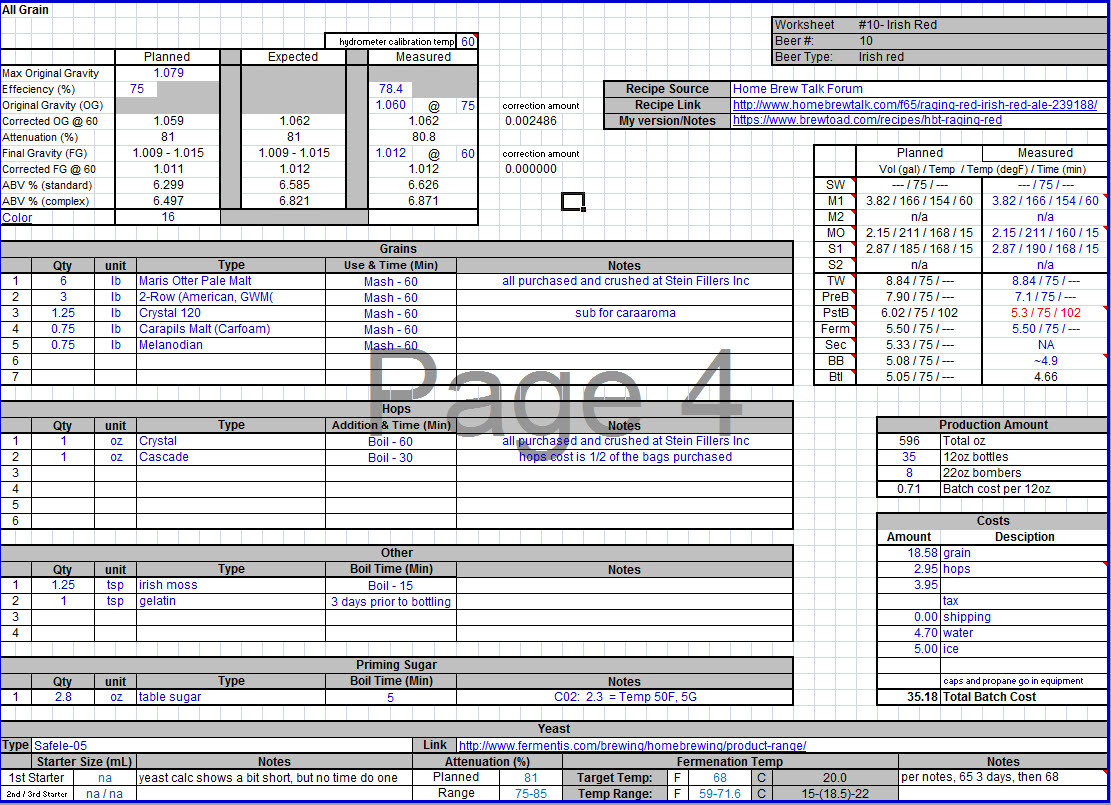
My second successful all-grain beer!  I decided to make a few adjustments to the original recipe.  I upped the grain bill instead of adding honey to keep the same ABV and replaced the 2 row pale ale with Maris Otter Pale to allow for a thicker mouth feel.  I tried it 2.5 weeks after bottling while home for thanksgiving and it was okay.  After 6 weeks the beer has hit its stride and is pretty nice.  The beer came out smooth, malty, and very tasty.  The head is a little off and collapses pretty fast, but it appears to be carbonated about right.  Definitely worth doing again, but I might make some minor adjustments to the hop schedule.

My Brew Notes

Execution Notes

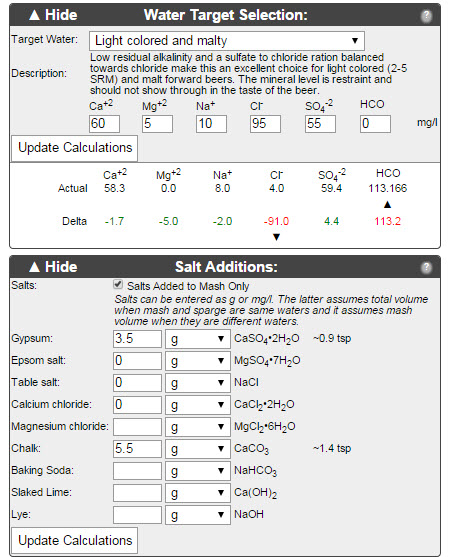
I’ve always used RO water as I didn’t know what was in my home water for a long time.  When I finally figured out my water I learned that it comes from two sources which are pretty much on the opposite side of the spectrum and there is no way to know what is coming out when.  So I’ve continued to use RO water which is cheap at the filling station next to the grocery store (30 cents per gallon).  This was the first time I tried doing water adjustments from the RO water.  I bought some things last minute, but didn’t have anything to make Chloride adjustments.  I’ll work to get better at this, but was focused on doing too little rather than too much.

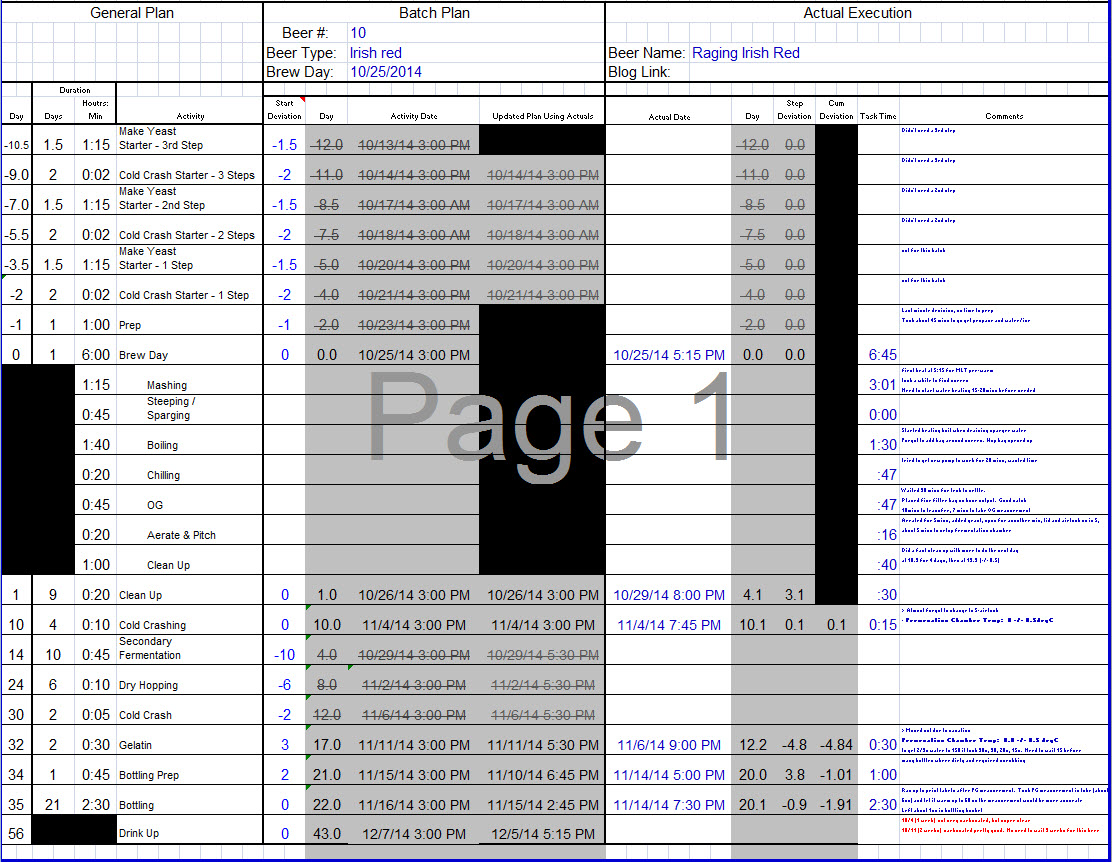
Had similar issue with the mashing again where I started hotter than planned and then dropped about 8 degrees over the coarse of the mash.  My numbers came out okay, so nothing to worry about on this batch but certainly something to work on.

I tried using a little pump from ebay to do a whirlpool (not a real whirlpool, but enough to keep the wort moving over the coils when chilling), but clearly wasn’t ready as I fussed with that for about 20-30 mins before giving up and just using a spoon to stir.

Other minor notes.  My measurements don’t seem to be too accurate as I gained wort from the post boil measurement to the fermenter.  Need to get better at that.  I allowed for 30 mins for the trub to settle and then used my filters for the post boil transfer which resulted in a very low sediment in the fermenter. I collected the yeast into a clean spagetti jar as practice for yeast washing.  The yeast came out really clean and if I do things right (sterile jar and water) it seems I can start re-using yeast in the future.

Schedule

Schedule

Recipe Info

Recipe

Water Adjustment

Water Adjustments

Recommendations for next time

  • When compared to a Red Seal Irish Red mine is more malty and not as hopped.  I think I’ll slightly up my hops a bit next time, but not too much.
  • Get pump to work
  • Take better measurements
  • Try harvesting yeast

#9 – Kolsch

Beer Name: Change

Style:  Kolsch

Alcohol: 4.5%

Color: 4

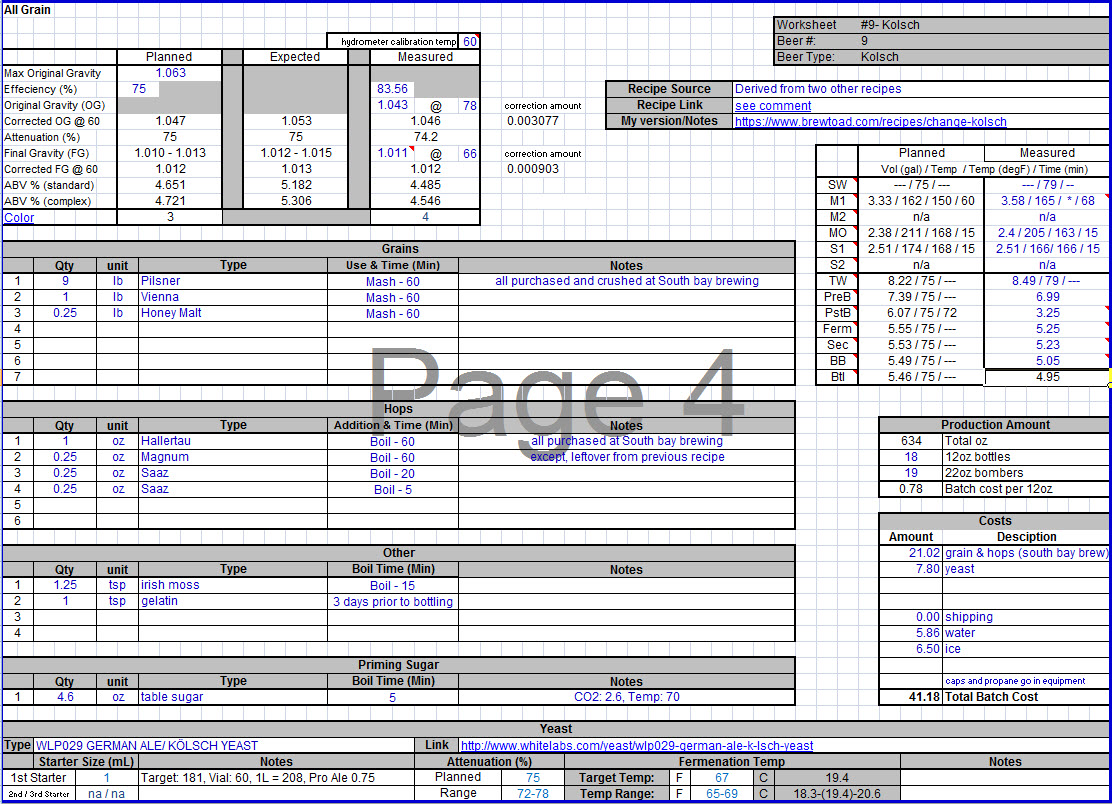
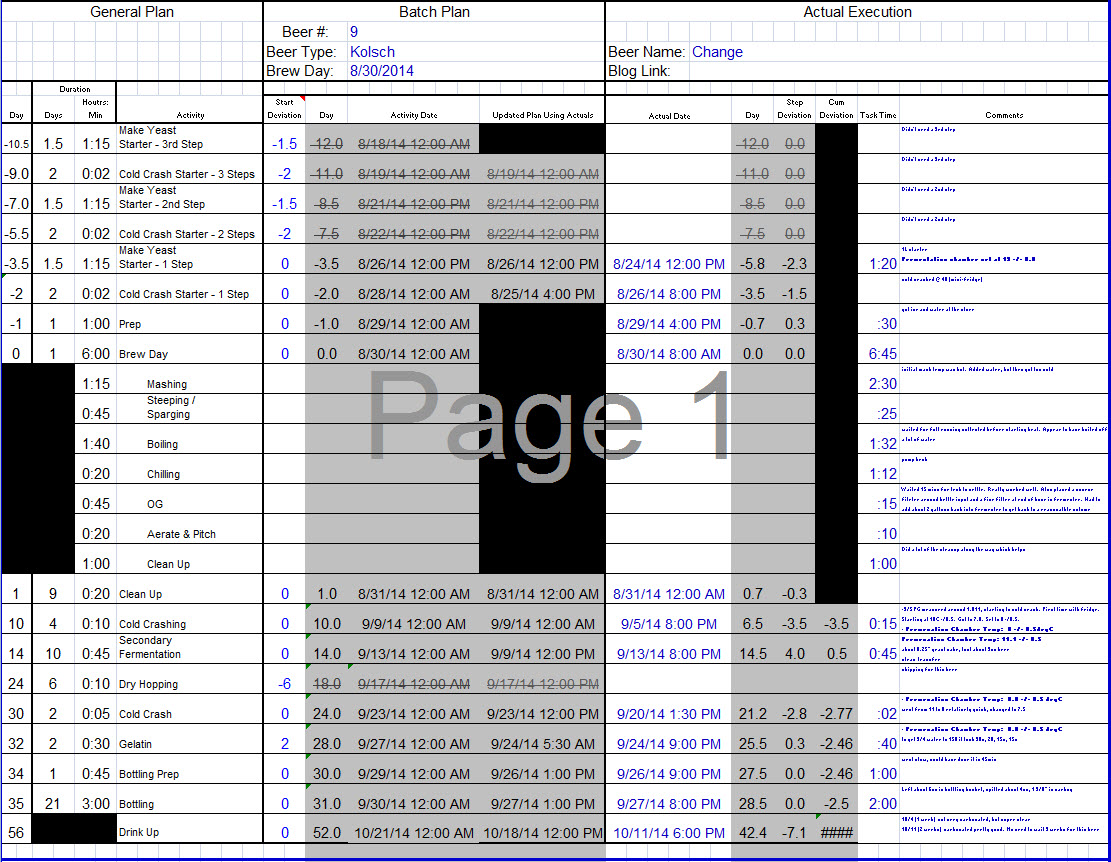
This is the second all grain beer that I’ve made.  After the last one blew up in my face, literally, my goal for this beer was to pick a simple recipe and really work on producing the clearest beer that I could.  During our summer trip to Denver I had several good Kolsches and decided that this is what I’d brew.  The brew day went well and the final product is a really nice beer.   Its refreshing to have and there is a good chance I do this one again, but maybe as a 10G batch next time since it goes down pretty easy.

My Brew Notes

Recipe Info

 Recipe

Execution Notes

The brew day went pretty well considering that last time I had stuck sparges and all-grain brewing was new.  My mash temps wavered around more than I’d like and will need to refine this.    I tried to use PH strips and iodine to check the mash, but have to say that I have no idea what I saw and will need to work on this more.  I did boil off more than I thought and had to add 2 gallons of water back in.  Though with that the gravity was on target.  Also, my pump broke so chilling took way longer than it should.  My plan to have a coarse bag around the metal screen in the boil kettle  and a fine mesh bag on the output side of the hose really helped me to remove most of the trub prior to going into the fermentor.  I cold crashed twice and used a secondary in addition to Irish moss in the boil and gelatin prior to bottling.  I’m not sure which helped the most, but I have a good beer.

Schedule

 Schedule

Recommendations for next time

  • Try hitting and maintaining the mash temp better
  • Plan for a higher boil off than most other people (try to turn down the burner a bit too)
  • See if I can figure out idodine and PH strips.

#11 – The Student (a Pliny the Elder clone) – Planning

Inspiration

For beer number #11 I decided that I wanted to see who well I can make a beer.  My last couple of beers have come out good to me, but I have no idea if they came out like they were supposed to.  So for beer #11 I’ve decided I’m going to do a clone recipe and then try to do a side by side comparison to see how I have done.  With that decided, I also want the beer to be ready fairly quick and I’ve been thinking about a hoppy beer since #6 Imperial Red IPA.  So what to pick.  I took a look through the beers that I’ve marked on Untappd for some motivation.  I really liked Shipwrecked by Mission Brewery, but after scouring the internet I couldn’t find any recipes for it and I certainly cannot make up one on my own.  When doing this I ran across several links for Pliny the Elder by Russian River Brewery (RRB).  I’ve had this a couple of times, once at the brewery and another time at Naja’s, and I think I’ll be able to get this again either at the Store or through a visit to Rollie.

Research

Recipe Notes

So after looking at a few pages I’ve discovered that this is going to take a bit of research as there is no definitive recipe.  I’ve done as much research as I can stand and have looked for articles and interviews about Vinnie Cilurozo (RRB owner and PTE recipe inventor) where he might give hints about the recipe.  Secondly, I’ve also looked for others that have cloned this beer and their direct comparisons to the real Pliny the Elder.  Lastly, I’ve taken some notes from those that do a comparison of their clone to their recollection of the Pliny the Elder which in most cases is probably suspect.  There are a ton of posts about that the recipe is great, which I imagine is the case, but I’m looking to hit PTE on the head if I can.

The starting point for the recipe is from an article from Zymurgy by Vinnie  in 2009.  In this article Vinnie gives a recipe for Pliny the Elder.  Apparently there was a typo in the first release that had the amounts sized for 5G instead of 6G, but the attached PDF is the corrected version.  Also on EC Kraus there is a reference to a recipe in Brewing Classic Styles by Jamil Zainasheff that may have had input by Vinnie.  I can see that the OG is much higher, the grain bill and hop schedule are different.  So at this point I think this recipe is not a clone, but rather just a good DIPA.

There is a rather good interview on the Sunday Session by the Brewing Network.  In this I’ve noted (as many others have reported)

  • generic extract is used, no pellets, for the 90 min and 45 min addition
    • The original recipe used a mix of CTZ and Warrior extract, but is now only generic
    • Sometimes they use pellets to dial in the right amount of hops as only whole cans are used.  Thought this didn’t seem significant
  • When Amarillo was added no other hop additions were reduced
  • All hop additions are pellet hops, ie no whole leaf additions
  • Crystal has been reduced.  No indication of how much

There is also a rather lengthy forum on HomeBrewTalk.com that I’ve gotten a few notes from.  #63 by RichBenn says this is pretty spot on, but maybe the comparison wasn’t side by side since the PTE he has is at a bar.  The quote below is one of the few direct comparisons that I’ve come across.

#431 by D-Train I had the opportunity to try my execution of this clone side by side with a bottle of Pliny tonight. Keep in mind that I’m fairly new to brewing and maybe experience would change the results. They were close, but there are a few things I would change next time.

1. Add Amarillo to the dry/late addition hops. The real Pliny was definitely weighted more to the citrus side. The clone had more dank/pine. I’ve read that Pliny now includes Amarillo.
2. Use only 2 hopshots for the first addition. I used 3 hopshots and the clone was more bitter. Earlier I posted that I was using hop extract for the recipe.
3. Make it lighter in color by reducing the crystal and/or boiling for 60 mins instead of 90 and/or increasing the dextrose. I scaled up the recipe and went with 14lb 2row, 0.6lb carapils, 0.6lb crystal, 12 oz dextrose. The clone was more orange and the Pliny more yellow.
4. Switch to RO water and the additions in the chemistry primer on this site. So far I’ve ignored water chemistry in my brews. I have high pH, high alkalinity tap water with chlorine and I think it’s limiting the full potential of my brews.

All said the above differences were not significant. With a few tweaks I don’t think a blind test would pick the real Pliny. Again it could simply be my execution of the recipe. Caveat emptor.

Some thoughts on this.

For #1, a look at the RRB website of Pliny the Elder and as the Sunday session interview notes that Amarillo is now in the recipe which wasn’t in the original.  Since I’m trying to do a taste comparison I’ve added Amarillo where I think it might go.

#2 shows he used hop shots.  In other articles (#85, 5 tips for better IPAs by Vinnie recommends extracts, and oldschool hints that a Sunday Session recording states the real PTE uses extracts too), it is noted that that the 90 and 45min additions of PTE are extract additions, so this is some good information.  Its also worth pointing out that the Vinnie recipe shows the AA values for each hops.  When looking online it seems that the AA levels are a bit higher that noted by Vinnie.  I don’t think I’m going to adjust for this now except for in the extract additions, but it might be something worth tweaking if I do this again.  Now there is the issue of converting the hops to extract amounts.  To do this I partially used two websites.  The first, from brewer’s friend,  I user to convert the hop additions to an IBU calculation.  The second I use to convert the IBU calculation into an extract amount.  The extract calculation uses a utilization faction which is more or less a function of the amount of time the extract is in contact with boiling wort and the amount of wort it can be in contact with.  I’ve noticed that it doesn’t quite account for the volume right, so I’ve looked at the html source to get the calculations and have made the needed adjustments.  The adjustments are slight and probably won’t make a difference in the end, but being an engineer I wanted to see the math done right.  My calculations show that 18.75mL and 4.34mL of extract is needed for the two additions.  From what D-train recommended 2 hop shots instead of 3 (I’ve translated this to be 10mL instead of 15mL) whereas I’m going to be even higher.  I think I’ll stick to my calculations for now and see what I think too, but it is probably that not only has Amarillo been added, but that the extract has gone down too to please more pallets and/or to reduce the cost (though RRB  does seem to make too many recipe decisions on cost).

#3, color, is interesting.   It seems to have been repeated by VTCCbrewer (#295) though one note on this one is that he mentions is volume is slightly low which would affect the color too. bobbrews (#131) has a similar suspicion as I do that perhaps crystal 40 is used rather than crystal 45 and MMjfan (#161) suggests 1/2 the amount crystal 40 at 0.3lbs.  After adjusting the recipe to this the OG sits at 1.071.  When looking at the PTE website is states an OG of 1.070, but if you look back through the web archives it can be seen that this was 1.071 circa 2005 (and 1.073 circa 2004). So I think this is on the right track and I’ll go with it.  Funny thing is that after making the adjustments I come up with a grain bill almost the same as Scott (bertusbrewery.com) on his PTE 3.0 review.  Aside from the fast that his reviews are a recollection of his tasting it at least feels nice that I’ve ended up with what one person thinks is pretty good after adjusting twice.

Water.  As noted in #4 water should be addressed.  My first attempt at water adjustments was on #10 Irish Red.  I didn’t quite have a handle on things then, nor do I really know what I’ve doing now, but I’ve been reading a lot since then and think I can at least do better.  Another HBT forum discusses PTE water which concludes by saq (#5) that the water profile should be:

  •  Calcium (CA) 76
  • Magnesium (MG) 13
  • Sodium (NA) 9
  • Bicarbonate (HCO3) 26
  • Sulfate (SO4) 133
  • Chloride (CL) 56

 Process Notes

per Vinnie’s article.

  • Mash will be at 151 (or the closest I can do this)
  • Stir in the dextrose at the start of the boil
  • ferment at 67
    • last two days drop to 60F to get yeast out then transfer to secondary
      • I won’t keep the yeast, but think I’ll cool to 52 to help clear things up as best as possible prior to mucking things up again with dry hops.
  • dry hop at 68F
  • Vinnie notes that he does a C02 blast every day or so to keep the hops in suspension.  I don’t have C02 for this, but will swirl like paradoc suggests in this post.
  • last 2 days of dry hopping is at cold crash temps
  • purge with CO2 if you have it….I don’t

In a (need to find link) Vinnie notes that PTE takes 21-24 days.   This is up to kegging so for me I need to add 3 days for fining and 3 weeks for bottle conditioning.  My schedule at 25 days, not counting conditioning, is pretty close to Vinnie’s schedule

  • 8 days fermenting
  • 2 days cool crash to 52
  • 7 days first dry hop, 12-5 days
  • 3 days second dry hop
  • 2 days cold crash
  • 3 days gelatin
  • 21 days conditioning

The yeast, Cal Ale WLP001, normally has an attenuation around 76.5% and according to White Labs attenuation ranges from 73-80%.  With the corn sugar, many people have noted that they can get near the a FG of 1.011 which places the attenuation around 85%. to get to 8.0% with the grain bill I’ve selected I’ll need to get 86.1% which seems within reason.

Finally, the name for my clone.  As is pointed out by RRB and many other sources, Pliny the Elder gave the name or at least recorded the name for hops as he was an author of many books.  From Wikipedia, it notes that:

He (Pliny the Elder) published a three-book, six-volume educational manual on rhetoric, entitled Studiosus, “the Student”

Just maybe my blog has enough rhetoric where you think I have the best plan possible to clone Pliny the Elder.

Rhetoric: the art of effective or persuasive speaking or writing, especially the use of figures of speech and other compositional techniques.

With that beer #11 will be called The Student

Links

Here are the list of links I bookmarked while researching this recipe.

 Recipe:  The Student

Ingredients

Grain

  • 13.25 lb Two-Row pale malt
  • 0.3 lb Crystal 40 malt
  • 0.6 lb Carapils (Dextrin) Malt
  • 0.75 lb Dextrose (corn) sugar

Hops

  • 90 min boil
    • 3.5 oz Columbus (US)
    • replaced with 18.75mL of extract
  • 45 min boil
    • 0.75 oz Columbus (US)
    • replaced with 4.34mL of extract
  • 30 min boil
    • 1.0 oz Simcoe (US)
  • 20 min whirlpool
    • 2.5 oz Simcoe (US)
    • 1.0 oz Centennial (US)
  • 12 days Dry Hop
    • 1.0 oz Simcoe (US)
    • 1.0 oz Centennial (US)
    • 1.0 oz Columbus (US)
    • 1.0 oz Amarillo (US)
  • 5 days Dry Hop
    • 0.25 oz Simcoe (US)
    • 0.25 oz Centennial (US)
    • 0.25 oz Columbus (US)
    • 0.25 oz Amarillo (US)
  • *Tomahawk/Zeus can be substituted for Columbus

Yeast

  • White Labs WLP001 California Ale Yeast
    • attenuation at 86.1% due to corn sugar

for 6.0 gallons into primary, Hopefully, net 5 gallons after hop loss

Original Gravity: 1.071
Final Gravity: 1.010
Efficiency: 75 percent
ABV: 8.0%
SRM: 4

Directions (mostly from Vinnie’s article)

  1. Mash grains at 151-152° F (66-67° C) for an hour or until starch conversion is complete.
  2. Mash out at 170° F (77° C) and sparge.
  3. Collect wort, bring to a boil for 90 mins
  4. Stir in dextrose
  5. Add hops as indicated in the recipe.
  6. After a boil and whirlpool, chill wort to 67° F (19° C)
  7. Transfer to fermenter.
  8. Aerate well
  9. Pitch yeast starter
  10. Ferment at 67° F (19° C) until fermentation activity subsides, then rack
    to secondary.
  11. Add first set of dry hops on top of the racked beer and age
  12. Then add the second set and age
  13. Then bottle after adding priming sugar.
 

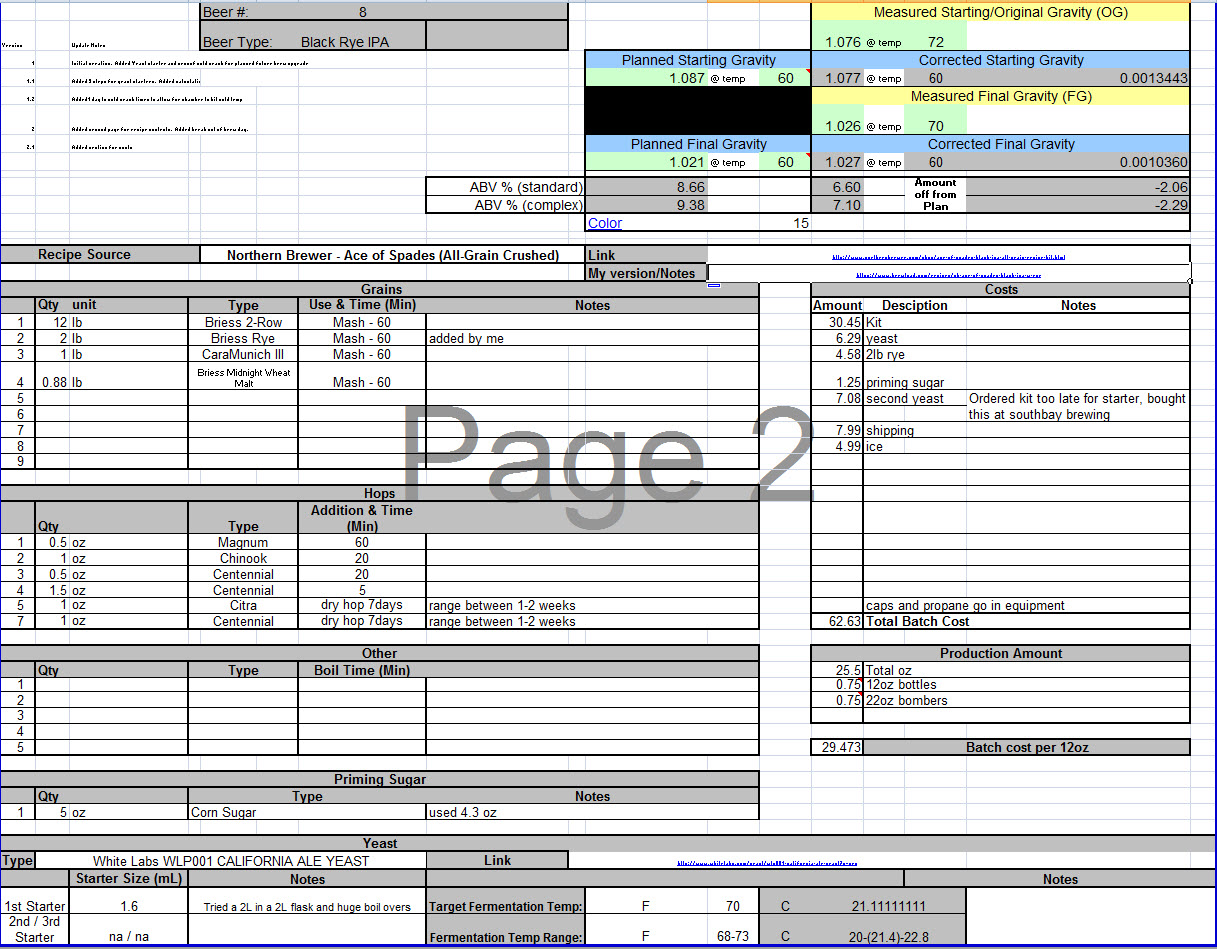
Beer 8 – Black Rye IPA

  • Beer Name: Burnin’ Spades RIPA
  • Style:  Black, Rye, IPA
  • Alcohol: 7.1%
  • Color: unknown

My first venture into all grain brewing has literally blown up in front of me.  So who know how it tastes, but here is what happened.   After coming home from vacation I saw liquid coming from the fermentation chamber.  When I opened the doors about 6 bottle or so had exploded at the bottom.  So I took everything out and cleaned things up, exactly what you want to do after a long travel day.  Just as I was putting the beers back in the fridge, the bottom of a six pack broke open and the bottles dropped maybe a foot.  Well all 6 of those bottles exploded.  Sounded like a bomb went off.  I was lucky no glass hit my face, but my legs and feet were not so lucky and had blood streaming down.  Now I had another mess to clean up.  So while I was cleaning that up 2 more bottles exploded just sitting on the sidewalk.  Awesome, I have bottle bombs.  Not wanting to loose everything. I place the remaining beer bottles in a cooler and inside my fridge.  That night I heads several more explode…sounded like a gun shot.  Hoping to save the beers, I planned to pop the tops on the remaining bottles and then re-cap them.  I put on my bomb squad gear (an old paintball face mask, a thick long sleeve, and some gloves) and reached into the cooler to take the tops off.  The first one gushed everywhere, same with the second, third and so on.  After a bit there was so much foam I was just feeling through the cooler to find unopened bottles.  Well needless to say this was a total loss.  I did try about half a glass full just to see what it was like and it was sweet almost like the raw wort.

So here is what I think happened.  During my last batch of beer my fridge died, so I didn’t really have good fermentation control while this beer was fermenting.  We had really hot days and warm nights.  I think the yeast shutdown due to the high temperatures.  I should have noticed that my final gravity reading was high and done something, but just moved right into bottling.  After I bottled I also replaced the AC unit with a min-fridge coils and was able to set the temp.  I think when I did this the yeast woke up again and started chomping on all the unprocessed sugars, thus creating my bottle bombs.

On the fun side, I got some 3/4″ stickers to make cap labels for my beers.  I got lucky and made labels for my previous beers as I had to move my bottles all around while cleaning.  Making a label is now part of my beer making process.

My Brew Notes

Recipe Info

 Recipe Notes

Execution Notes

Tried making a 2L starter in a 2L flask.  Resulted in a boil over.  Separated into two flask for the boil then recombined when they cooled.  Ended up with 1.6L of the 2L.

First time making all grain batch.  MLT filter was too small and got a stuck sparge.  I knew what my number were supposed to be, but wasn’t prepared to be able to measure if I was hitting them or not (ie. depth to volume conversions). Messed around switching in a different filter which caused the temps to go wild.  Through all the hops directly in which wasn’t so bad.  What was bad way the bag I had to catch the gunk at the output end of the hose when transferring to the primary got clogged up and ended up not using it which passed a lot of material in the fermenter.  When transferring to bottling bucket the the filter around the tube also was causing problems so a lot of material ended up in bottles.  Need to do this better next time

Schedule

  • Brew day: 6/13/2014
  • Cold Crash Start: N/A (Broken fermentation chamber)
  • Secondary Fermentation: 7/2/2014
  • Dry Hopping: 7/29/2014
  • Cold Crash 2: N/A
  • Gelatin: N/A
  • Bottling Prep: 8/4/2014
  • Bottling: 8/5/2014

Recommendations for next time

  • Get the filtering down much better
  • Make sure the fermentation chamber is working
  • Know numbers better and know how to take measurements

Priming Suggestion

homebrewtalk.com forum

Currently I gravity feed my immersion chiller. I’ve used a pump in the past, but from what I’ve discovered it isn’t the rate of water that is effecting the rate at which i can chill the beer (gravity is just fine) it is the amount of wort that comes in contact with the beer. So to help things along I’ve been stirring with a spoon. I’m working on adding a pump into my brewing setup to make life easier on me, but I’m not too sure how to go about priming the pump. I plan to have a simple inlet and outlet pipes with 90 bends to push the water around and through the coils of the chiller. I’m not going for a whirlpool affect, at least for now, with my wimpy pump but am just trying to move the wort around the coils without me stirring. For the record i have a valve on my kettle, but I don’t want to use that as I have a filter around it that I want to keep clear until I transfer to the primary. . Anybody have any suggestions of how to go about priming my setup? I know adding another valve would solve my problem, but I’m looking for other ideas as I’m not too keen on this idea as I want this idea to work with several other kettles. Thanks.

Priming Suggestion

Beer 7 – Belgian Witbier

Beer Name: Whenever Wit

Style:  Belgian Witbier

Alcohol: 4.31%

Color: 15

Recipe Source:  Midwest Belgian Witbier

This came out to be a pretty nice beer.  I didn’t do anything fancy (no secondary, no fining agents) and was pretty happy with the result.  I added a bit of fresh orange peel to give it a bit more zest though I’m not sure how much it added over the dried peel that came with the kit.  It has a nice hazy color and is well carbonated (if not too much).  If I were to do this again I’d reduce the coriander a bit as it is a bit strong for my tastes, but not so much that it ruins the beer.

My Brew Notes

Ingredients

  • 6 lbs wheat LME
  • 8 oz Carapils (30 min steep)
  • 1 oz Liberty hops (60 min)
  • 1 oz bitter orange peel (10 min)
  • 1 oz coriander (10 min)
  • 1oz sweet orange peel (10 min) added by me
  • 1 oz Hallertau (2 min)
  • Yeast: White Labs WLP400

Execution Notes

I didn’t do anything fancy for this beer and left it in the primary untouched the whole fermenting time (and a bit longer).

I did a bit more research of Witbiers and came across this post which suggests fresh orange peel.  So I added a bit of my own to the kit.

For what it's worth, Here's a quote from July/Aug 2007 BYO mag, Style profile (Witbier) by Jamil Zainasheff:

"The best way to add citrus character is with fresh citrus. The Petrified bits of orange peel often used may be authentic, but fres zest has a much brighter character. Select tangerines or oranges with a nice bold, fresh, aroma...Use a citrus zester to peel the very surface of the skin and avoid digging deep into the white pith as it is bitter and lacks citrus character. Measure the zest by weight, targeting about 1 to 2 ounces in a 5 gallon batch."

His recipe is in that article, as well. (calls for 1.5 oz of zest and .4 oz of crushed coriander.)

So I didn’t do the yeast start calculations correctly and subtracted 5 months instead of 4. This resulted with an over pitch but given that I hit my OG and FG right on everything worked out just fine.

Also, I didn’t clean out my tubing right away on brew day.   Some of the hoses look stained now.  I’m not sure if they would have been if I’d cleaned everything right away, but I think they are still usable.

Finally, my fermentation could get down to cold crashing temperatures.  At one time it was iced over so I had to let the thaw out.  This was the first time it has ever iced up and after that either something broke in the A/C unit or just I’ve never tried to cold crash when it was this warm.  Either way my fermentation chamber could only get down to ~55 degF and that was with it running almost none stop.  I really hope it didn’t break.

Schedule

  • Brew day: 3/15/2014
  • Cold Crash Start: 4/22/2014
    • Broken fermentation chamber
  • Secondary Fermentation: N/A
  • Dry Hopping: N/A
  • Cold Crash 2: N/A
  • Gelatin (32): N/A
  • Bottling Prep: 4/27/2014
    • No early prep
  • Bottling: 4/27/2014

Alcohol

  • Target Starting Gravity: 1.042
  • Starting Gravity:  1.042
  • Target Final Gravity: 1.010
  • Final Gravity: 1.009
  • Alcohol %: 4.31

Color: 15

Recommendations for next time

Use less coriander.  This beer is a bit too spicy for my tastes. Still good, but I’d tone it down a bit as suggested in the same Witbier article mentioned above

For what it's worth, Here's a quote from July/Aug 2007 BYO mag, Style profile (Witbier) by Jamil Zainasheff:

As for the coriander, he says, "I gently crush the coriander with the back of a heavy spoon to expose the inside of the seeds, which gives it a fairly strong, spicy character versus whole seeds. The level of coriander is probably the area most brewers overshoot, resulting in a really peppery beer. The desired result is a gentle background spicing not an overwhelming one. If you have fairly fresh coriander, start with .4 oz per 5 gallon batch during the last 5min of boil."

Mash Tun

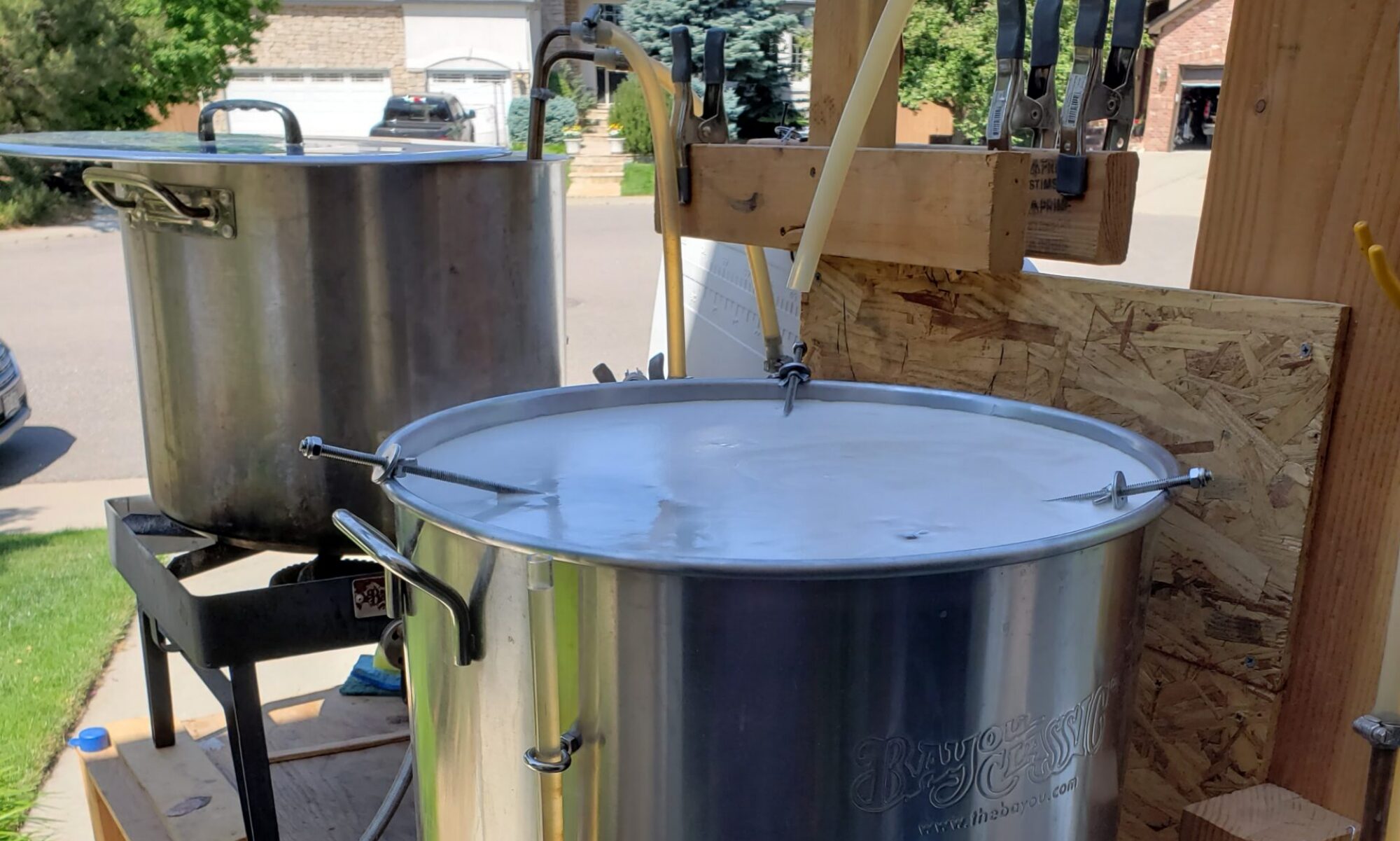
I’ve finally completed my mash tun build, the last new tool I need for all grain brewing.  For my birthday, I got a 110qt Igloo Glider Roller cooler from Costco,  a ball valve kit, and a 12″ stainless steel water heater connector.  With this I will be able to brew the highest ABV beers (all the way up to 18%) in 10 gallon batches.  Which is perfect since I recently got new kettles and burners (see my other post on that) to do 10 gallon batches too.

With my new gear I’ll had to do was take out the coolers drain and then put in my own drain.  Well 8 hours later I’ve finally finished.  Apparently my cooler is thicker than most coolers so I had to get some additional parts.  With my new parts, a female to female (f2f) extension and a male to male extension,, both stainless steel, I had a setup that was too long and I had a leak out of the hole.  So I then hand cut the f2f extension on both sides to shorten it up.  Still this leaked.  I tried several other configurations with additional washers and they all had leaks.  Then when I was in DC I stopped at a My Local Home Brew Store  and got some help from some very friendly staff and purchased several O-rings, some heat resistant some not.  Well when I got home I still could screw things together without having an ever so slight leak.  Note, the leak on the outside was slow, which is bad, but I was also worried that it was leaking into the center of the cooler, even worse.  So then Chase and I made another trip to another hardware store and picked up some more washers and another pipe wrench.  With that final trip to the store I finally got a mash tun that didn’t leak.  Hallelujah! Oh, and it turns out I never needed to cut through any of the f2f extension, but it works just fine short too.

One final note, most coolers advertised size includes the lid and seems to not always add up correctly.  This cooler, Igloo Glide Roller Premium, is advertised as a 110qt cooler.  When you measure up to where the lid hits 13.5″ (which is needed to keep the heat in while mashing) and take out the bump in the inside this cooler ends up being about a 96qt cooler.  Still plenty big for 10G batches, but something to be mindful when selecting a cooler.

Mash Paddle

I created my mash paddle with some help from my father-in-law, Bob, to get me upgraded for all grain brewing. Bob gave me a very nice piece of Lenga (aka fireland cherry) wood from Chile to make the paddle out of. We were able to quickly cut out a paddle shape and drill out some holes one afternoon. Then in another afternoon I used a dremel and rounded out all the edges. Followed by some good old hand sanding with 60 and 200 grit sand paper. It isn’t the fanciest of paddles, but should work out for be great. Now I just need to get the MLT to stop leaking and I’ll be ready for my first batch of all grain brewing.

Beer 6 – Falconer’s Success I2PA

Beer Name:  Falconer’s Success I2PA

Style:  Imperial IPA (Rouge XS Imperial IPA clone)

Alcohol: 7.78%

Color: 18

Recipe Source:  Austin Home Brew Supply, Extract

Well this is the first beer I’ve made that I’d say that I’m impressed with and say that it is a success.    My beers prior to this were okay, but not impressive and I always thought they were not just quite right.   This beer is clear, well carbonated, the hops aromas are amazing, and the taste is excellent.  It is the second beer since I made the fermentation chamber  and I’ve gotten better at the process in general, but either way I’ve happy with the outcome.  In fact I was so pleased with my beer that I had a stupid childish grin on my face that Lisa couldn’t help to notice when I had the first bottle.  At any rate this beer is my first true success!!!


My Brew Notes

Ingredients

I used the extract kit provided in the link above and added 1oz falconer’s flight hops added with the other dry hops.

Execution Notes

This was the first time ever and used my new flask.  I used 6.5oz DME to 1.8mL of water for the first step up.  I had a hard time pouring DME into flask and should pour water into measuring cup then back into flask.  I also had a major boil over and lost about 0.100mL.  For the second step up I used fermcap-S and have zero boil over!!  Water took longer to get to boiling since there was so much water stretching the time out more than it should in the future.

This batch went pretty well on brew day.  I didn’t do any of the pre-brew day tasks except for buy the ice and water and managed to do the rest while I was brewing without any delays between steps.  After about 10 mins into the boil I had to run to the restroom and somehow managed to have a boil over in that time.  I was concerned that I might have lost a lot of wort since I wasn’t there to witness the boil over, but after a few questions to the home brew forums I think I was able to determine what happened which caused me to miss my ABV by 0.66%.

The fermentation took off quite vigorously and foamed out of the bucket on the second day.    I noticed I had an issue when I saw a fruit fly buzz across the webcam.  I was afraid that when I opened the fermentation chamber that there were going to be flys and larva everywhere, but fortunately there was just the one fly.  This was a pretty sticky mess to clean up, but wasn’t too bad to wipe out of the chamber.  I cleaned out the airlock and let to do its thing

I used a secondary (cold crash prior to transfer) and gave it my first try at dry hopping.  I finished things off with gelatin and a cold crash prior to bottling.  I also tried something new this time when transferring to the bottleing bucket.  I placed the siphon in a fine nylon filter which I think helped keep out some of the muck.  I don’t know how affective this was, but it is simple to do and will add this to my normal routine.

Yeast: White Labs California Ale V WLP051

Schedule

  • Brew day: 1/4/2014
    • Boilover
    • Vigous fermentation mess
  • Cold Crash Start: 1/13/2014
  • Secondary Fermentation: 1/23/2014
  • Dry Hopping: 2/25/2014
  • Cold Crash 2: 3/3/2014
  • Gelatin (32): 3/4/2014
  • Bottling Prep: 3/7/2014
  • Bottling: 3/8/2014
    • nylon filter around siphon

Alcohol

  • Target Starting Gravity: 1.80
  • Starting Gravity:  1.077
  • Target Final Gravity: 1.020
  • Final Gravity: 1.022
  • Alcohol %: 7.78

Color: 18

Recommendations for next time

Watch the boil over.  I lost about 0.15G affecting the OG.

“New to Me” Brew Toys Upgrade

In a fortunate sighting on Craigslist, and a very understanding wife, I was able to get some “new to me” equipment for very very cheap to allow me to do all grain brewing for up to 10G batches.  The stuff could use some cleaning, but I got:

  • 24G stainless steel kettle with thermometer, sight tube, valve, and bazooka screen.
  • 16G stainless steel kettle with thermometer and valve.
  • 2 propane burners.
  • 6.5G glass carboy with top, thermometer tube, and 3 piece airlock.
  • 2000mL Erlenmeyer flask with stopper
  • homemade stir plate (no stir bar)

[singlepic id=165 w= h= float=center]


I had this great plan on how to do incremental upgrades from 5G extract brewing to 5G all grain brewing then to 10G all grain brewing, but this purchase basically jumps me right up to being able to do all grain brewing now!  I’m still going to do a couple of 5G batches to start so that I can figure out how to all grain brew and to understand my equipment a bit more, but stepping up to 10G batches will mean that I have/need/get to brew less and will have to do more fun things with Lisa and Chase.