Beer 6 – Falconer’s Success I2PA

Beer Name:  Falconer’s Success I2PA

Style:  Imperial IPA (Rouge XS Imperial IPA clone)

Alcohol: 7.78%

Color: 18

Recipe Source:  Austin Home Brew Supply, Extract

Well this is the first beer I’ve made that I’d say that I’m impressed with and say that it is a success.    My beers prior to this were okay, but not impressive and I always thought they were not just quite right.   This beer is clear, well carbonated, the hops aromas are amazing, and the taste is excellent.  It is the second beer since I made the fermentation chamber  and I’ve gotten better at the process in general, but either way I’ve happy with the outcome.  In fact I was so pleased with my beer that I had a stupid childish grin on my face that Lisa couldn’t help to notice when I had the first bottle.  At any rate this beer is my first true success!!!


My Brew Notes

Ingredients

I used the extract kit provided in the link above and added 1oz falconer’s flight hops added with the other dry hops.

Execution Notes

This was the first time ever and used my new flask.  I used 6.5oz DME to 1.8mL of water for the first step up.  I had a hard time pouring DME into flask and should pour water into measuring cup then back into flask.  I also had a major boil over and lost about 0.100mL.  For the second step up I used fermcap-S and have zero boil over!!  Water took longer to get to boiling since there was so much water stretching the time out more than it should in the future.

This batch went pretty well on brew day.  I didn’t do any of the pre-brew day tasks except for buy the ice and water and managed to do the rest while I was brewing without any delays between steps.  After about 10 mins into the boil I had to run to the restroom and somehow managed to have a boil over in that time.  I was concerned that I might have lost a lot of wort since I wasn’t there to witness the boil over, but after a few questions to the home brew forums I think I was able to determine what happened which caused me to miss my ABV by 0.66%.

The fermentation took off quite vigorously and foamed out of the bucket on the second day.    I noticed I had an issue when I saw a fruit fly buzz across the webcam.  I was afraid that when I opened the fermentation chamber that there were going to be flys and larva everywhere, but fortunately there was just the one fly.  This was a pretty sticky mess to clean up, but wasn’t too bad to wipe out of the chamber.  I cleaned out the airlock and let to do its thing

I used a secondary (cold crash prior to transfer) and gave it my first try at dry hopping.  I finished things off with gelatin and a cold crash prior to bottling.  I also tried something new this time when transferring to the bottleing bucket.  I placed the siphon in a fine nylon filter which I think helped keep out some of the muck.  I don’t know how affective this was, but it is simple to do and will add this to my normal routine.

Yeast: White Labs California Ale V WLP051

Schedule

  • Brew day: 1/4/2014
    • Boilover
    • Vigous fermentation mess
  • Cold Crash Start: 1/13/2014
  • Secondary Fermentation: 1/23/2014
  • Dry Hopping: 2/25/2014
  • Cold Crash 2: 3/3/2014
  • Gelatin (32): 3/4/2014
  • Bottling Prep: 3/7/2014
  • Bottling: 3/8/2014
    • nylon filter around siphon

Alcohol

  • Target Starting Gravity: 1.80
  • Starting Gravity:  1.077
  • Target Final Gravity: 1.020
  • Final Gravity: 1.022
  • Alcohol %: 7.78

Color: 18

Recommendations for next time

Watch the boil over.  I lost about 0.15G affecting the OG.
“New to Me” Brew Toys Upgrade

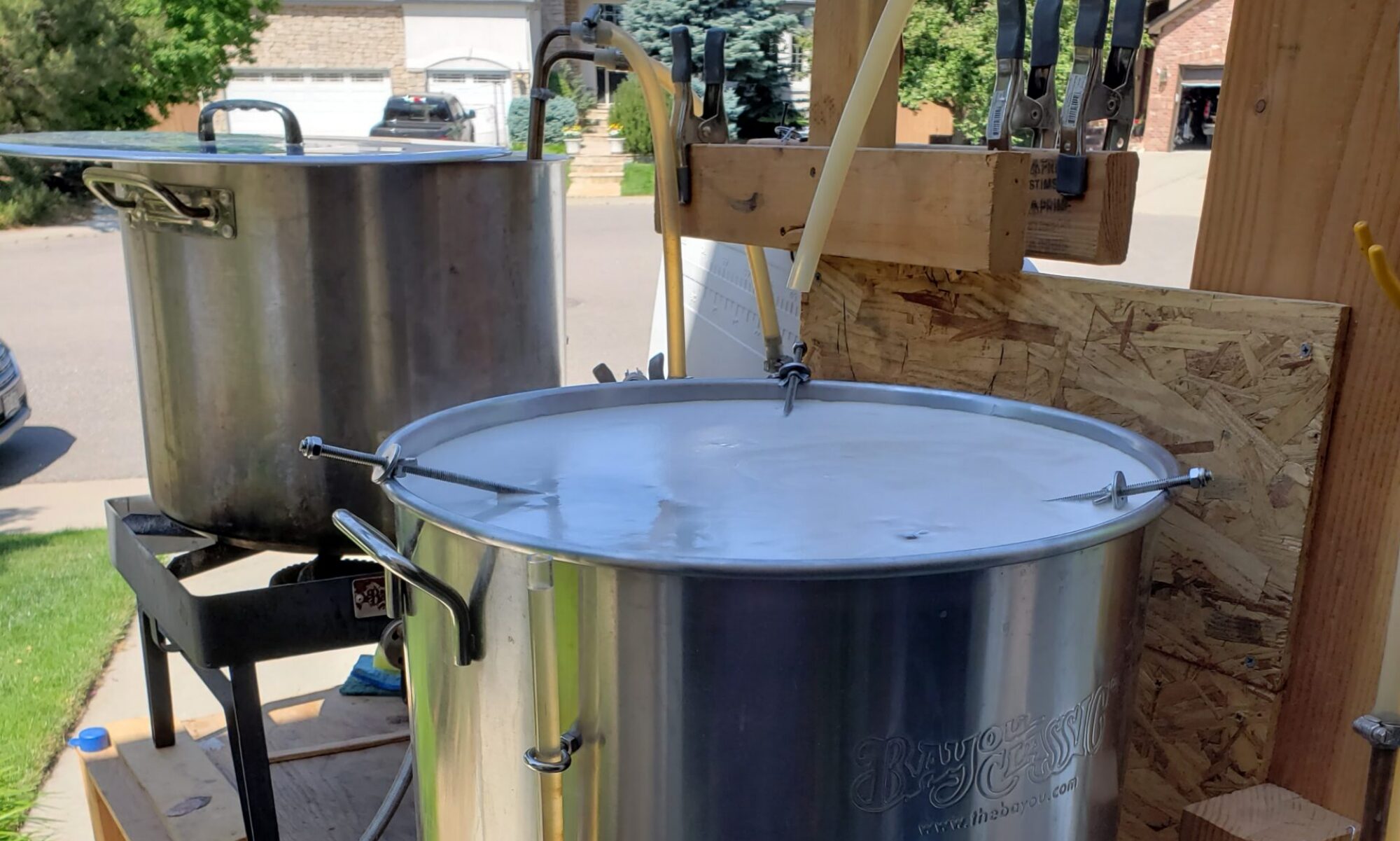
In a fortunate sighting on Craigslist, and a very understanding wife, I was able to get some “new to me” equipment for very very cheap to allow me to do all grain brewing for up to 10G batches.  The stuff could use some cleaning, but I got:

  • 24G stainless steel kettle with thermometer, sight tube, valve, and bazooka screen.
  • 16G stainless steel kettle with thermometer and valve.
  • 2 propane burners.
  • 6.5G glass carboy with top, thermometer tube, and 3 piece airlock.
  • 2000mL Erlenmeyer flask with stopper
  • homemade stir plate (no stir bar)

[singlepic id=165 w= h= float=center]


I had this great plan on how to do incremental upgrades from 5G extract brewing to 5G all grain brewing then to 10G all grain brewing, but this purchase basically jumps me right up to being able to do all grain brewing now!  I’m still going to do a couple of 5G batches to start so that I can figure out how to all grain brew and to understand my equipment a bit more, but stepping up to 10G batches will mean that I have/need/get to brew less and will have to do more fun things with Lisa and Chase.

All Grain Upgrade Plan

I’m getting ready to make the leap into all grain brewing and am pretty excited, but I want to do it right.  I don’t want to buy things to turn around a few batches down the road and wish I had bought something else.  So I want to either make sure the things I buy now will work for future upgrades.  A couple of key things to keep in mind is that I am doing 5 gallon batches now, but might want to do 10 gallon batches in the future.  Also, I like high gravity brews which requires more grain to get the more sugars, so again I need to think about the volume capability of the upgrades.

Key Items for all grain brewing

  • Hot Liquid Tank – HLT
  • Propane or Electric Burner
  • Mash/Lauder Tun – MLT
  • Mash Paddle
  • Kettle / brew pot

To get into all grain brewing from what I have now (see my tools here) I will need to get a mash/lauder tun (MLT), a mash paddle, and a large kettle.  I’ll explain my logic as I go through each one.

Hot Liquid Tank – HLT

A HLT is a fancy brewers way of saying a pot or kettle for heating water.  The hot water here will go into the MLT.  I have an existing 5G stainless steel pot which will be sufficient for 5G batches.  For 10G batches I’ll need a large pot, but my plan will be to buy a larger pot when time comes for this.  At the very least I’m not buying something now that won’t be used later.

Propane or Electric Burner

I have an existing 38,000 BTU burner from the turkey fryer kit I bought to get into home brewing.  From my calculations my burner should be good for batches up to ….TBD

To eventually do a 10G batch I have calculated that I’ll need about a TBD burner.

Mash/Luader Tun

Since a MLT isn’t needed for extract brewing I don’t have any existing equipment and will have to buy something new.  Seems like when someone gets into a really fancy brewing setup the MLT is a stainless steel pot, but many successful and far cheaper options use a converted cooled as they can easily be converted into an MLT and are fairly inexpensive.  Additionally, MLTs can be made for fly sparging or batch sparging.  I’m going to plan to do batch sparging as it seems this is relatively foolproof and the advantages for fly sparging aren’t too great.   I want to be sure that the MLT that I end up with will be good for 5G batches now and 10G batches in the future.

A high gravity (barleywine) 10G batch will have 45lbs amount of grain and at most 27.25  gal of water in the MLT at one time.   Remember the space in lid usually counts as part of the volume for a cooler so plan for a slightly larger cooler.  From this I get a cooler size with at least 94qt of internal space.   Well a 100qt coleman extreme cooler is going to only have about 80.25qt of internal space, but I figure I won’t be making any 10G batches of barelywine and will call it good.  Also, many poeple have recommended that a 70 qt (17.5G) is good for up to 10G batches.  The coleman extreme cooler comes highly recommended since it has a drain groove through the bottom.  With this cooler in mind a 5G batch will have a volume of 18 qt.    So with that in mind a 70-100qt cooler should be good into the future.

So I received a 100qt coleman extereme cooler for my birthday, but I have some questions about it as it isn’t as I thought it would be.  Read more on the Home Brew Talk Forums.

Mash Paddle

I’ll need a mash paddle.  I’ve read to use a hardwoord such as maple makes a good paddle.  Also, when making the paddle drill/cut good size holes in it to break up the dough balls well.

Kettle Upgrade

As I mentioned below I’m planning to use my existing kettle 7.5G kettle to become my HLT and then will purchase a new kettle.  Since I want to to small brewing upgrades without having to discard things in the future I’m planning to buy a kettle that will work for 5G and 10G batches, but to save money now I’m going to pass on any of the extra gizmos (thermometers, valves, sight tubes) for now.

Other posts suggest that a 80 qt (20G) stainless steel pot/kettle can do 10G batches.

In my quest to selecting a kettle I asked for some help with the selection criteria on homebrewtalk.com forums (here).


All Grain Kettle/Pot Quality Criteria

homebrewtalk.com forum

As with many posts I’m working to step up to all grain brewing, but I don’t want to have to do this again in a year so I’m trying to figure out the right criteria for selecting a kettle. I really don’t want to think in a year from now, “If only I had known …. before I bought my kettle”.

From what I’ve read here is my starting point
1) Choose stainless steel:

as opposed to aluminum which will pot over time

2) Choose 20G or greater kettle size:

I’d like to be able to do 10G batches if my heart desires. A 20G kettle will allow for high gravity 10G batches, smaller kettles will make things moer challenging. also, this eliminate the frequently suggested keggle idea as this is only a 15.5G kettle.

3) Can live without built in valves for now, but can upgrade late if desired:

I’m brewing without valves with no problems. I know valves will most likley make things easier, but it isn’t a firm requirement. Additionally, and perhaps more importantly its possible to punch/cut/drill holes and add valves at a later time, if/when desired

Open questions
4) Does 1-3 sound right, particularly #3?

I’ve read a lot of forums and such so far to get here, but I’m new to this and from what I’ve learned from doing extracts is that there is a lot to thing about when.

5) Does base thickness matter?

Seems like there are ranges from 1mm to 5mm. With most hovering around 2mm. I’m guessing this is for even heat distribution, but how much is enough

6) Does side thickness matter?

ranges from not specified to 1mm to 2.5mm. Seems like just about anything would work. Any issues with punching holes on a thin one later to add valves?

7) Need to be NSF certified?

Some claim to be, many don’t specify

8) build construction/materl

I’m not too familiar with the things I’ve seen a) aluminum wrapped/sandwhiched in stainless steel, b) 20 gauge stainless steel, c) 18/10 Stainless Steel, d) 18/10 T304 stainless steel, e) 3-Ply Bottom, and many more

9) Anything else?

I’m probably way over thinking this as I’ve seen posts from many happy brewers with pretty much all the pots I’ve taken a look at, but I haven’t been able to find any criteria for choose a kettle other than size recommendations. thanks for any feedback.

All Grain Kettle/Pot Quality Criteria

Beer 5 – Honey Bacon Smoked Porter

Final Beer Name:  Where’s the Bacon???

Style:  Smoked Bacon Honey Porter

Alcohol: 6.49%

Color: 35

This is my first beer since making my fermentation chamber and using my improved process with a drill pump and paint mixer.  Besides enjoying the beer I’ve had a lot of fun using my new toys and working on making better better.

The first sip was on new year’s eve which is a few days early for the 3 weeks in the bottle.  The beer wasn’t very carbonated so I waited a few more weeks to 1/18/2014 see if it just needs more time or perhaps the bacon fat killed off my bubbles.  Also, there appeared to be no bacon flavor which is kind of disappointing.  I was really worried that it would be bacon-y so I’m much happier to err on this side of the line, but wish there was still a hint of bacon.  I’m wondering if the flavors might come out a bit better after more time in the bottles.

Well the final taste test still doesn’t have much/any bacon flavors or aromas, but that’s okay.  The beer has a really smokey flavor with a nice smooth mouth feel.     The beer seems very clear, which I’m not too surprised as there was almost no trub in the carboy after transferring to the bottling bucket.  There isn’t too much carbonation, but enough to say it isn’t flat.  I’m wondering if the bacon has impacted that, I’ve read the bacon fat can kill the bubbles.


My Brew Notes

Ingredients

This recipe is a specialty brewing kit plus a few of my add ons.  The kit is from Midwest Brewing Supply and is a Honey porter extract brewing kit which includes (I forgot to take notes on the specifics:

  • some specialty grains, maybe?
  • Some extract
  • Honey (30 mins)
  • 1oz Kent Goldings hops (60min)
  • 1oz Cascade hops (2 mins)
  • priming sugar

then to get some smoke flavor I added

And for the bacon flavors I dry-hogged” as mentioned on BYO.com which suggests 5oz of bacon added like a normal dry hop schedule.  To get there I started with

  • 1lb of uncooked bacon

Execution Notes

Schedule

  • Brew day (0) – 11/9/2013
    • No boil over which is good.
    • Fermenting didn’t start for about 36 hours.  Worried that yeast didn’t take, but I did see bubbles before pitching it so it should have been fine.  Will look to yeast starter going forward as recommended by boydster in other post
    • Bubbles for quit after about 1.5 weeks.  I was going to do a test but broke my hydrometer.  I’ll probably update. my process to do hydro tests with the hydrometer attached to fishing line so that I don’t waste beer.
    • No or really slow bubbles on day 11.
    • waited a couple of days since I couldn’t do a hydro check for the moment.
  • Cold Crash Start (13) – 11/22/2013
    • Since the fermenting took longer than expected I delayed the cold crash a couple of days.  Should look into taking measurements.
    • It took about 1 day for the chamber to reach the cold crash temp.  I changed the cold crash temp to ~40 so that the A/C wouldn’t turn on every 3 hours.  Probably get it closer to 36 for the next crash
  • Secondary Fermentation (16) – 11/25/2013
    • The auto-siphon had a gap at the siphon to tubing.  I’m pretty sure I exposed the beer to a lot of oxygen.  Need to get some clamps before the next transfer.
    • I left the chamber off for ~ 1 day for the beer to more naturally rise back to room temp.  Near room temp I turned on the chamber which the heat pad did a bit of work for the last few degrees.
    • Chamber set for 19.5 +/- 2.0.
  • Dry “Hogging” (27) – 12/6/2013
    • In reading about how to do the bacon it was clear that I needed to remove as much fat as possible so that the beer doesn’t stay flat.  I’m not sure why, but apparently the fat will cause the beer to not hold the carbonation or something.  So to do this I started with my 1lb of bacon and trimmed off as much fat as I could with a knife.  Then I cooked the bacon in the oven on a rack that would allow for the grease to drip out.  A few times while is was cooking and while flipping the bacon I used a paper towel to absorb the standing grease on the bacon.  When it was all cooked my 1lb of bacon was about 3.5oz which was short of the 5oz I was targeting.  With the bacon cooked I simply open up the carboy and dropped them in.
  • Cold Crash 2 (31) – 12/10/2013
  • Gelatin (32) – 12/11/2013
  • Bottling Prep (35) – 12/14/2013
  • Bottling (36) – 12/15/2013
    • Very little trub in the carboy and I don’t think I sucked it up into the bottling bucket.  I’m not sure if this is due to the gelatin (which I don’t really see at the bottom as much as I thought I would) or from doing the first cold crash.
    • Bottled 22 220z bombers, and 11.5 12oz bottles for a total of 588.5oz (22*21+11.5*11).
    • Set the fridge to 20+/- 2 for carbonating
    • Took about 3 hours to bottle and clean up.  Need to track times for other steps to better understand how long it takes to do things.

Alcohol

  • Target Starting Gravity: 1.06
  • Starting Gravity:  1.059
  • Final Gravity: 1.011
  • Alcohol %: 6.49

Color: 35

Recommendations for next time

  1. Look into using more bacon and/or stripping the bacon flavors out using vodka before brewing the beer
  2. Might use a little less smoke, Weyermann grains, by ~1/4lb to allow more of the honey flavor to show.

Specialty Grain Brewing Process – Ales

homebrewtalk.com forum post

I’ve only been making beers for a short while and it seems that I’ve had so many questions about how to go about doing it while I was in the middle of making the beer. So I wrote down my game plan for specialty grain brewing process on my little website (not a commercial site). I’ve also pasted the text in here in case you don’t care to go to a unknown location, but I didn’t mess with the formatting. Let me know if you have any advice and perhaps this will help someone else. Thanks. 

http://bt.beerprojects.com/wordpress/?p=716

Specialty Grain Brewing Process – Ales

Low OG with All Extract brew

homebrewtalk.com forum post

I have a brew that was supposed to have an OG of 1.080. When I measured it I got a reading of 1.077 after the correction (1.076 at 66 degrees). I took several measurements, spinning the hydrometer each time and consistently got the same result. I have a slight boil over, but other than that there really isn’t anything I can figure out how I didn’t get the expected OG. On top of that, using brewer’s friend extract calc I should be at 1.085 (5.25G water, 12 lbs LME).


Any ideas where I might have messed up?

Low OG with All Extract brew

First Yeast Starter

After posting my beer making process to the Homebrew forums someone suggested that I look into yeast starters to ensure that I was getting enough yeast to ferment the wort.  A sign of low yeast is a slow start and from my last beer I certainly saw that with the fermentation not starting for 2-3 days.

After looking to this a bit more it turns out that I haven’t had enough yeast for most of my beers (low pitch count).  With my discovery being around Christmas time some of my wish list items were a 2000mL Ehrlenmeyer flask and a stir plate.  You can do starters without these, but the flask makes the heating and cooling pretty simple and the stir plate pretty much ensures that you only need one step for most beers.

Well I got the flask to use for my first yeast starter, but the stir plate is on back order.  For the beer I was making the OG is supposed to be 1.080 and according to the yeast calculators online I needed two steps.  The first step could fit in the flask, but the second step needed 4.5L which is too much for my flask.  I had a huge boil over here and it made quite the mess.  In the end though my yeast starter went great and caked out nice.

For the second step I wanted to avoid the boil over and after reading several forums there is some stuff called Fermcap-S which is an anti-foaming agent.  I went to the local home brew store and got a small bottle.  With just a few drops of this stuff I had no risk of a boil over.  This stuff is a must have.  Well since the second step wouldn’t fit in my flask I got some of the new cooled wort and put it into the flask (after pouring out the liquid from the first step).  I then shook it around real to break up the yeast cake and poured the whole thing into the cooled wort.  After a good amount of mixing I poured the contents into two containers, the flask and a emtpy bottle.  I followed the same steps and ended up with a really nice yeast cake in both.

When I used the starter for my beer I took some of the wort and gave each a good shake then pour the contents into the wort.  After just a few hours the yeast was fermenting and it did it so vigorously that I got a block air lock and a big mess in the fermentation chamber.  I had a good amount of foam on top of the wort when I packed it all up so hopefully with a bit more care I can avoid the air lock blockage, but my yeast starter sure worked great. Next time I hope to have the stir plate in hand to see how much easier (one less step) things go.   If you are curious about the steps to make a starter I’ve written my process on a fixed page so that I can keep refining it.


time to cold crash temperature?

homebrewtalk.com forum post

I’m curious to see how long others are seeing it take for the beer to get to the child crashed temperature? I have mine in a new self made fermentation chamber and it seems that it takes about 15-20 hours for it to go from 70 degrees to 37 degrees. The chamber is cold right away, but the thermal transfer is taking longer than I imagined

time to cold crash temperature?